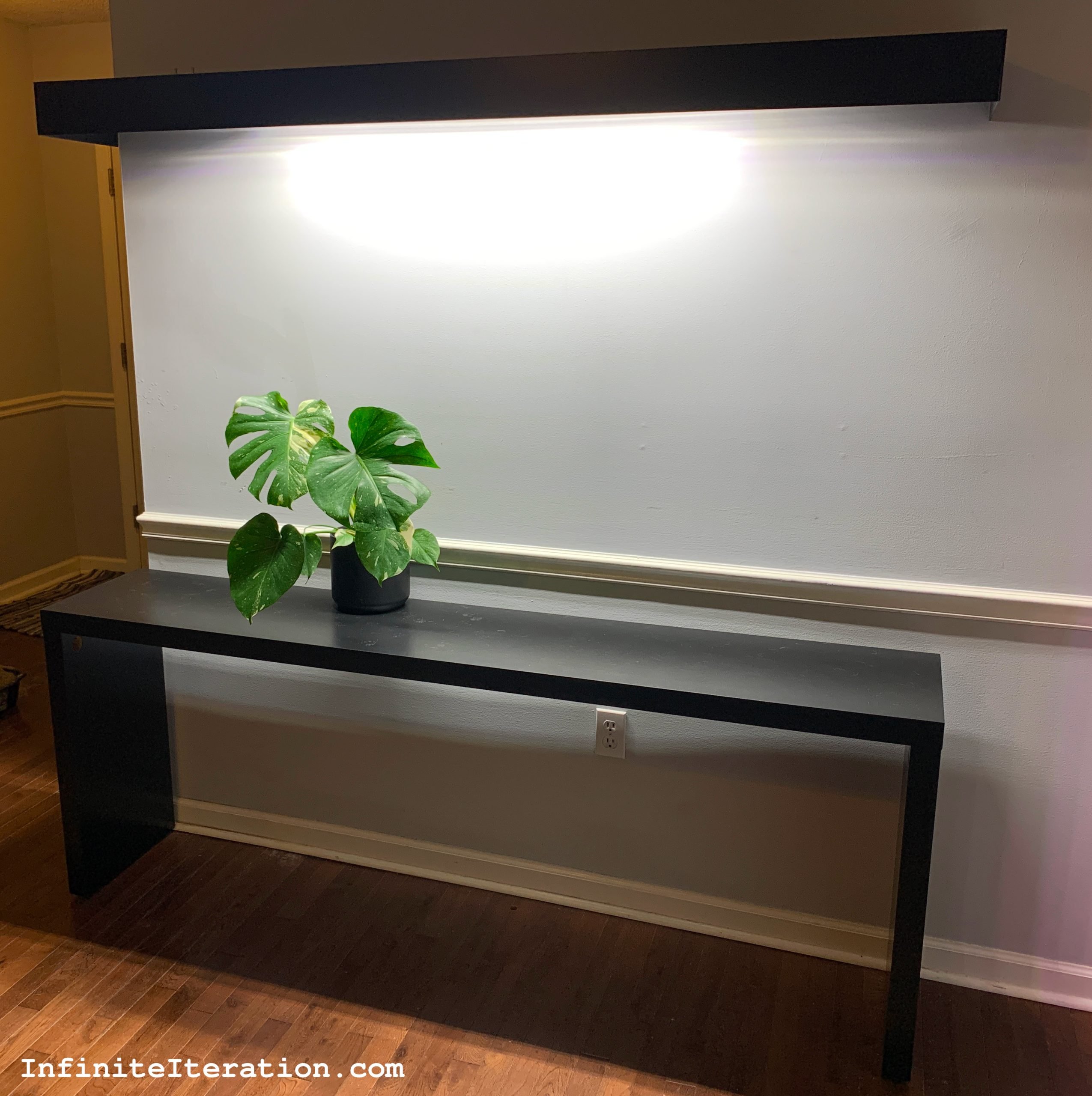
For the past few years, I’ve been collecting tropical aroid houseplants, but I don’t have enough south-facing windows for them all, so I decided to try grow lights. Most grow-light fixtures look out of place in a home and detract from the plants’ cozy aesthetic. I wanted a cleaner integration, so I decided to build my own design by integrating the 4-foot Mars Hydro VG80 full-spectrum grow lights (2x 40W light bars) into a 74-3/4″ IKEA Lack floating shelf.
Shelf Modification
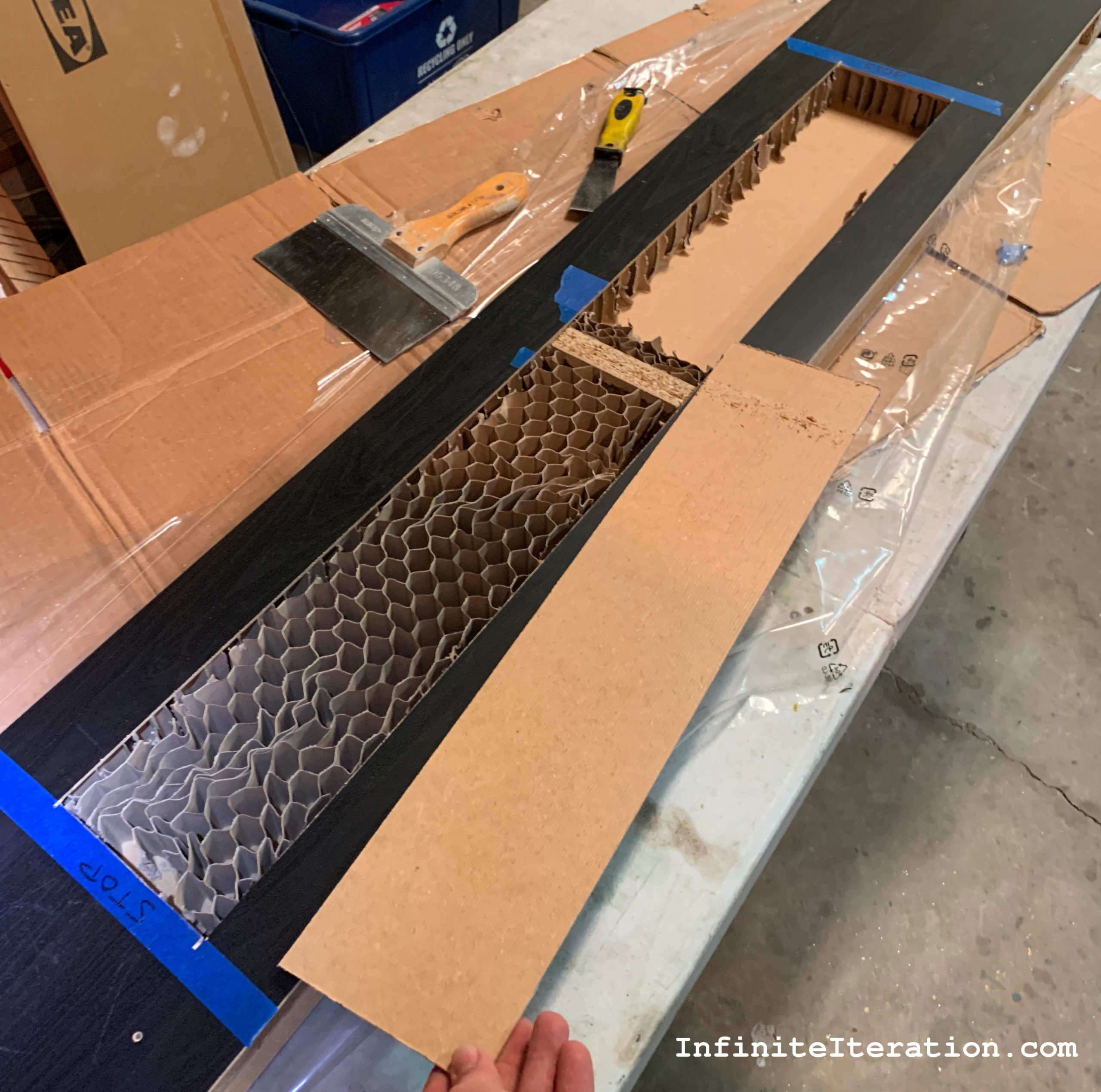
I hollowed out the shelf from the underside to make enough room for the lights. This video helped me get a preview of the shelf interior to plan modifications before cutting. I used a combination of oscillating multitool and circular saw (w/ very shallow depth of cut) to make the opening, and I used a trim router to get the edges more precisely parallel. I also created a slot in the rear of the shelf to pass wiring through. After all the cuts were done, I used salvaged hardboard pieces to close out the internal structure and spray-painted the exposed unpainted surfaces matte black.
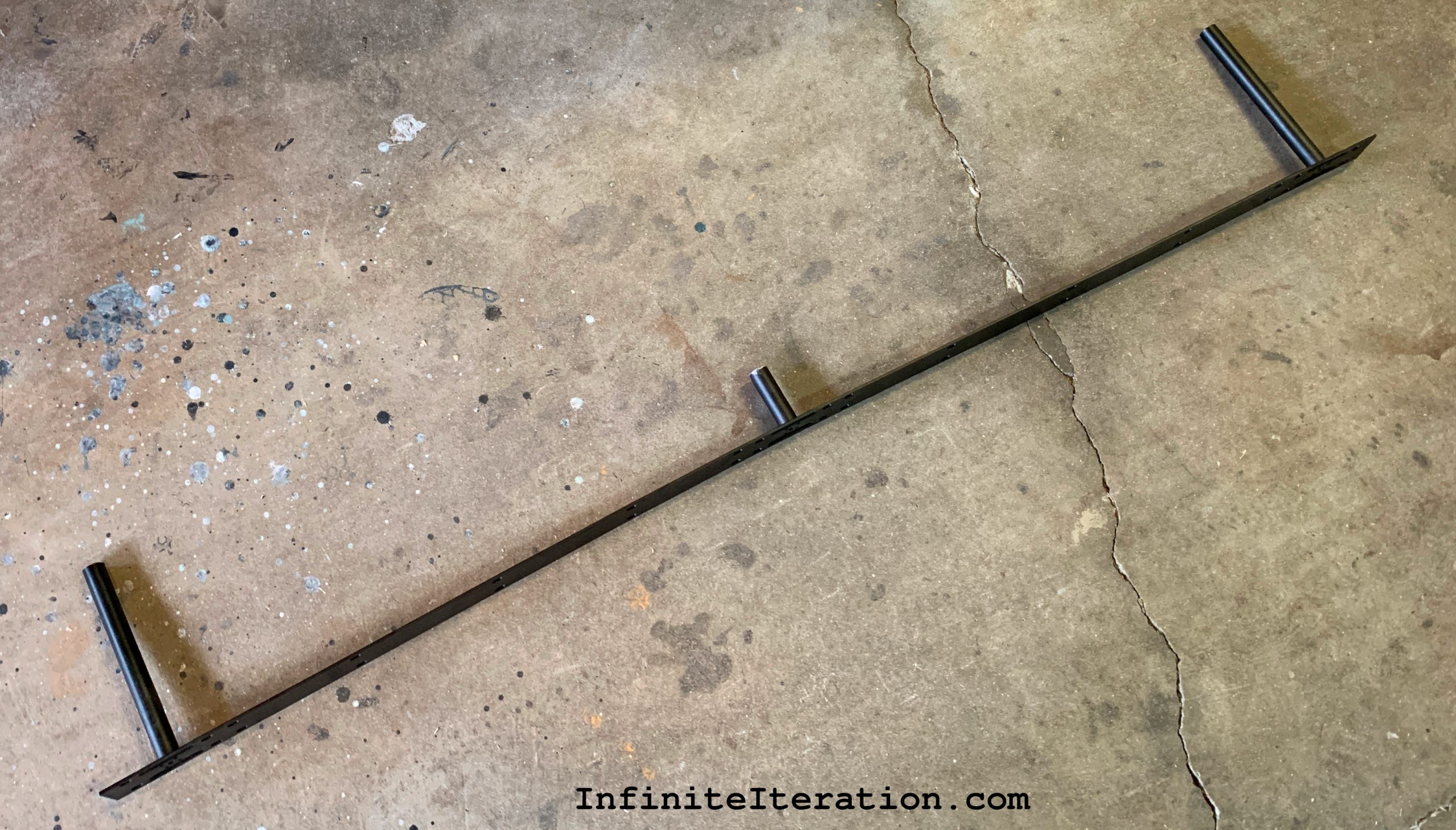
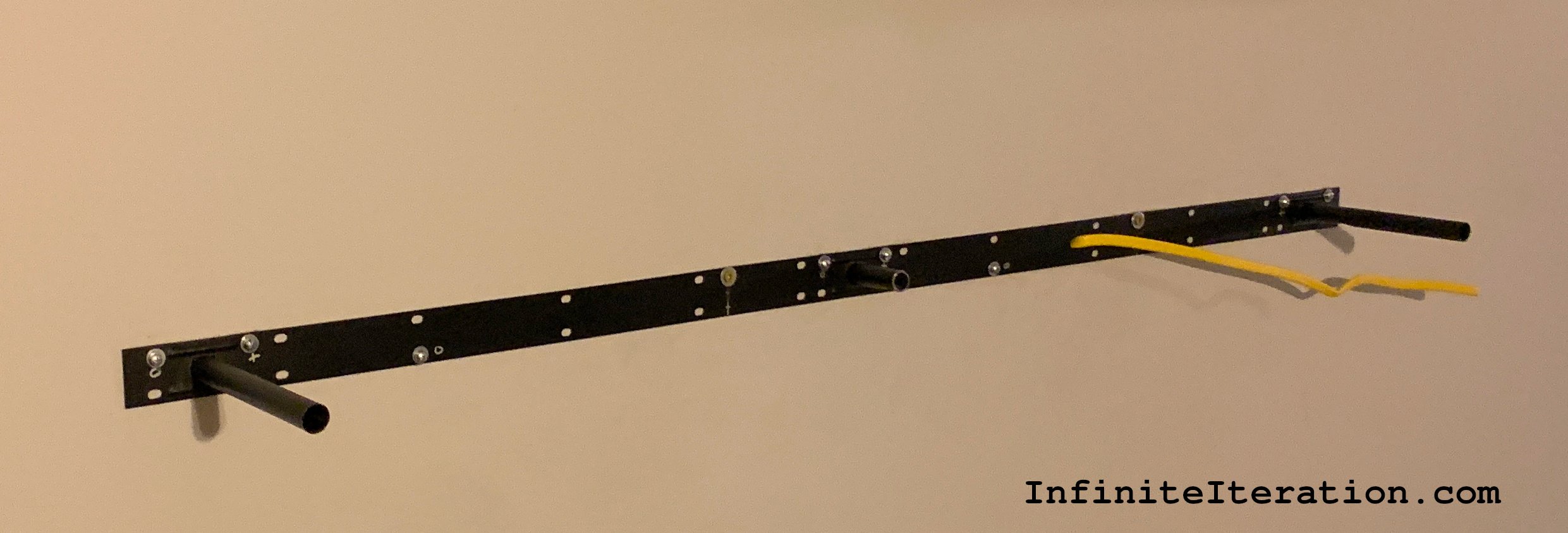
The shelf’s steel mounting bracket uses three support tubes running front-to-back. I shortened the middle support tube to accomodate the lights, and I trimmed down the shelf’s corresponding chipboard support block.
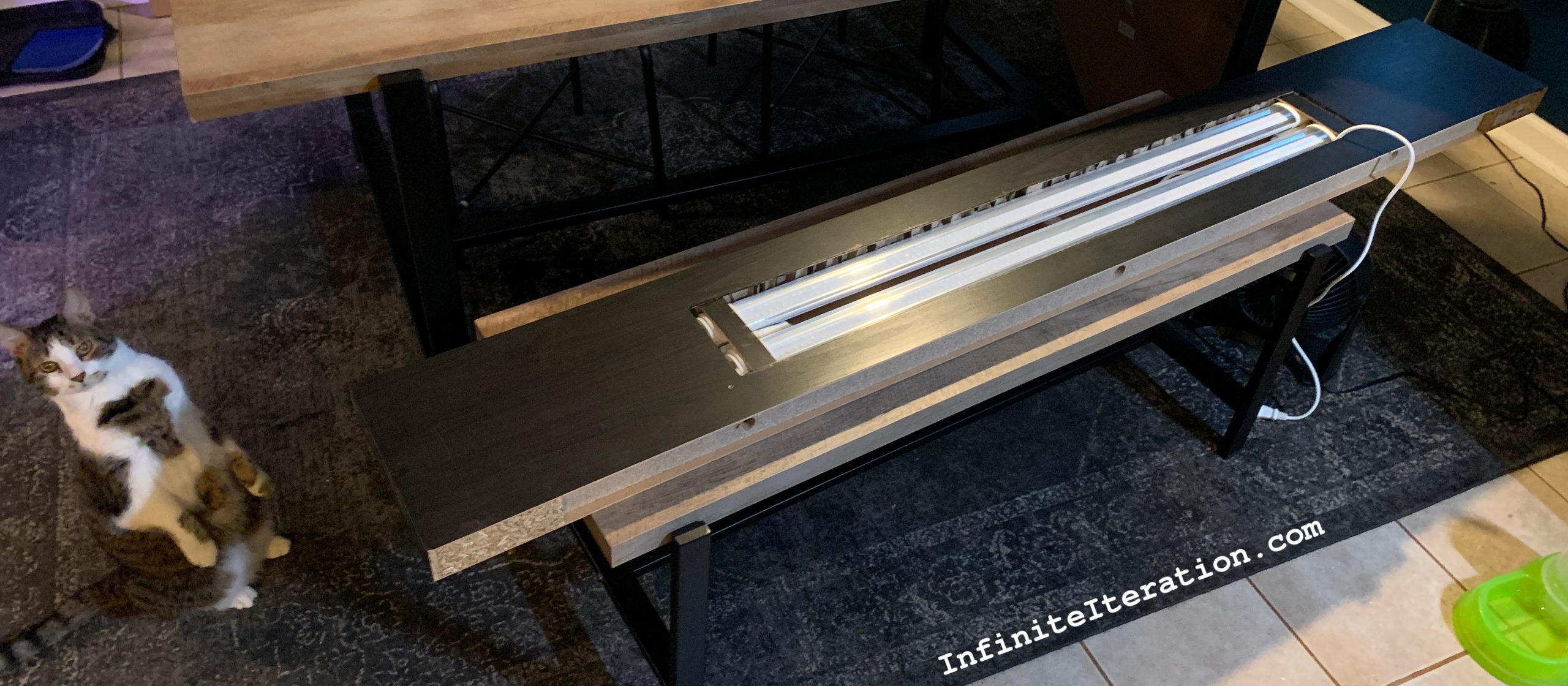
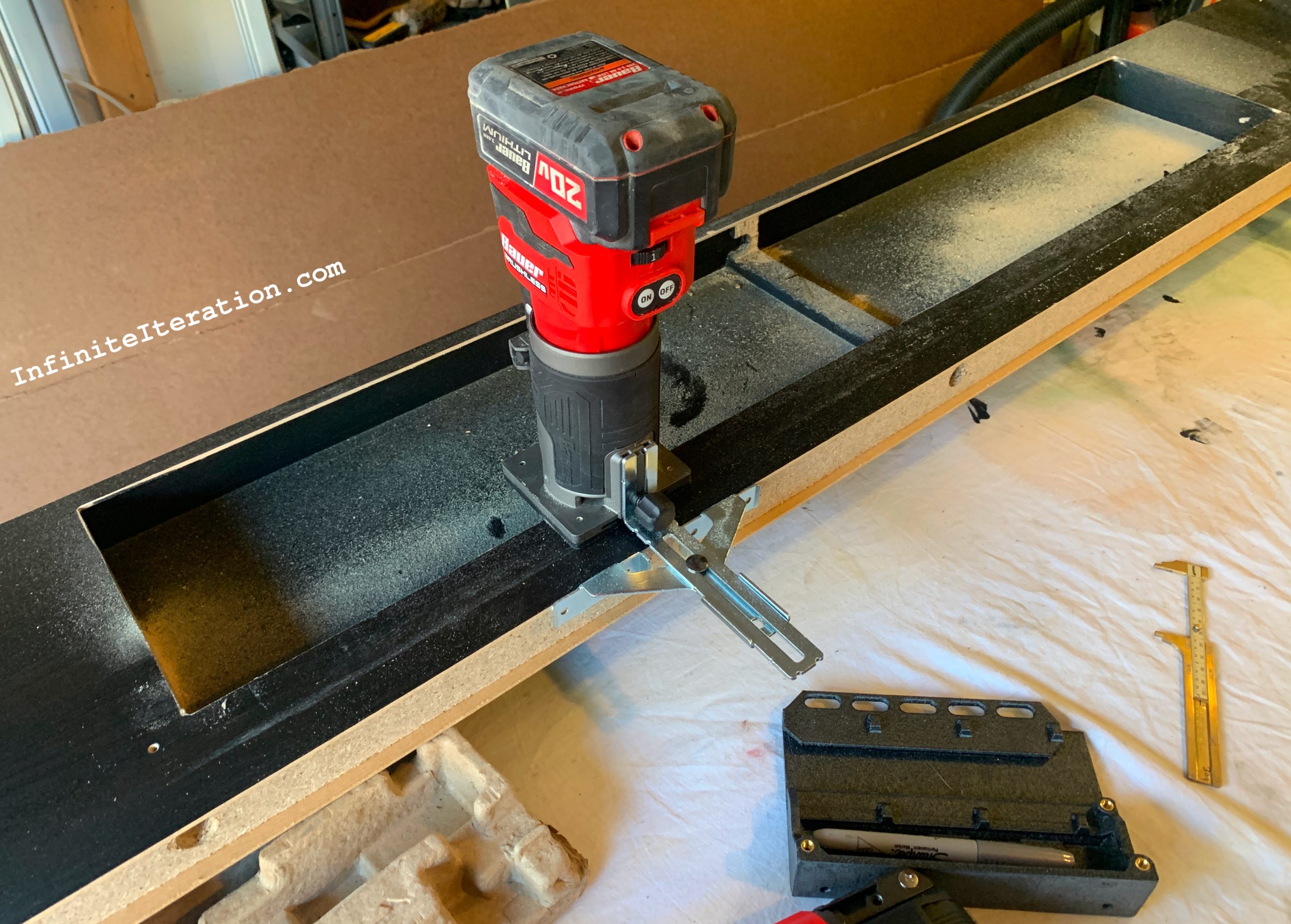
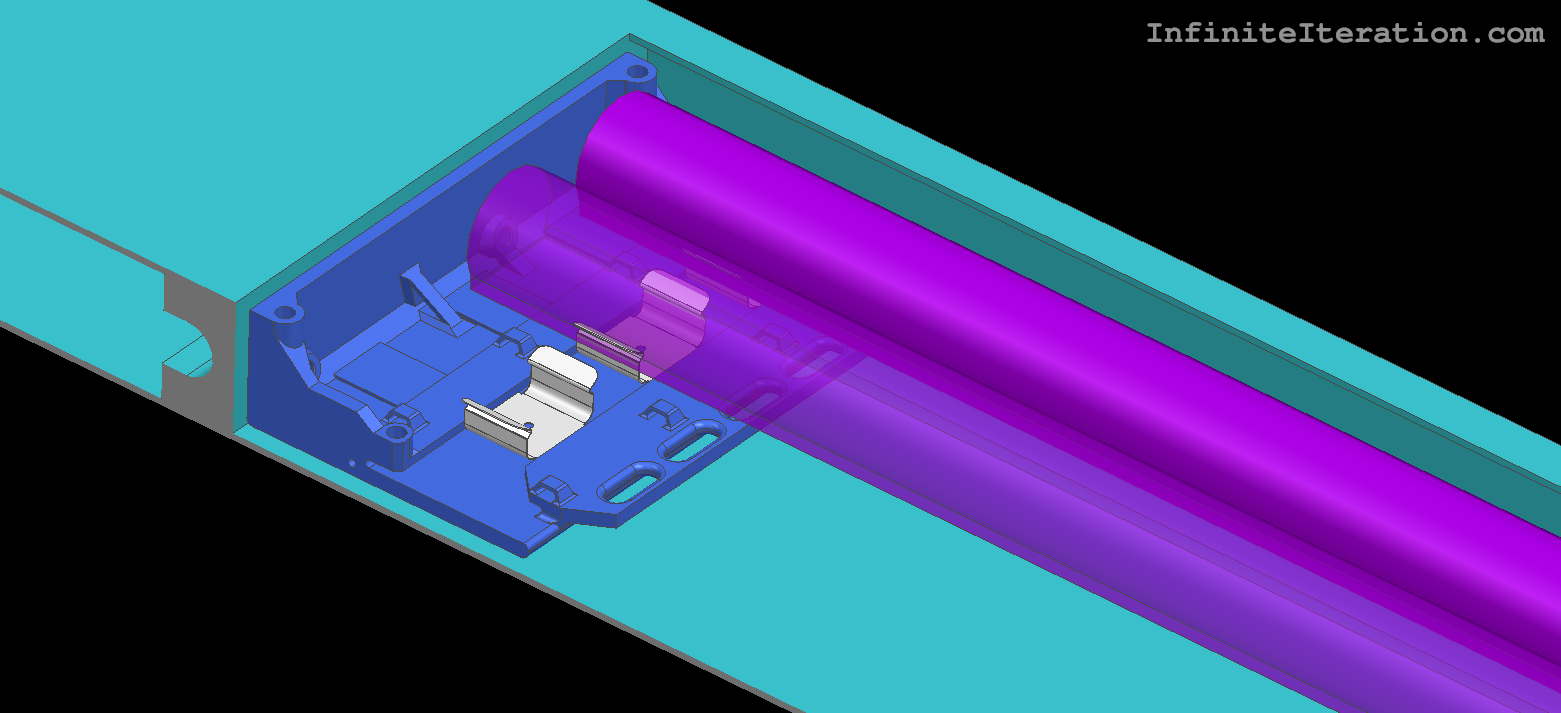
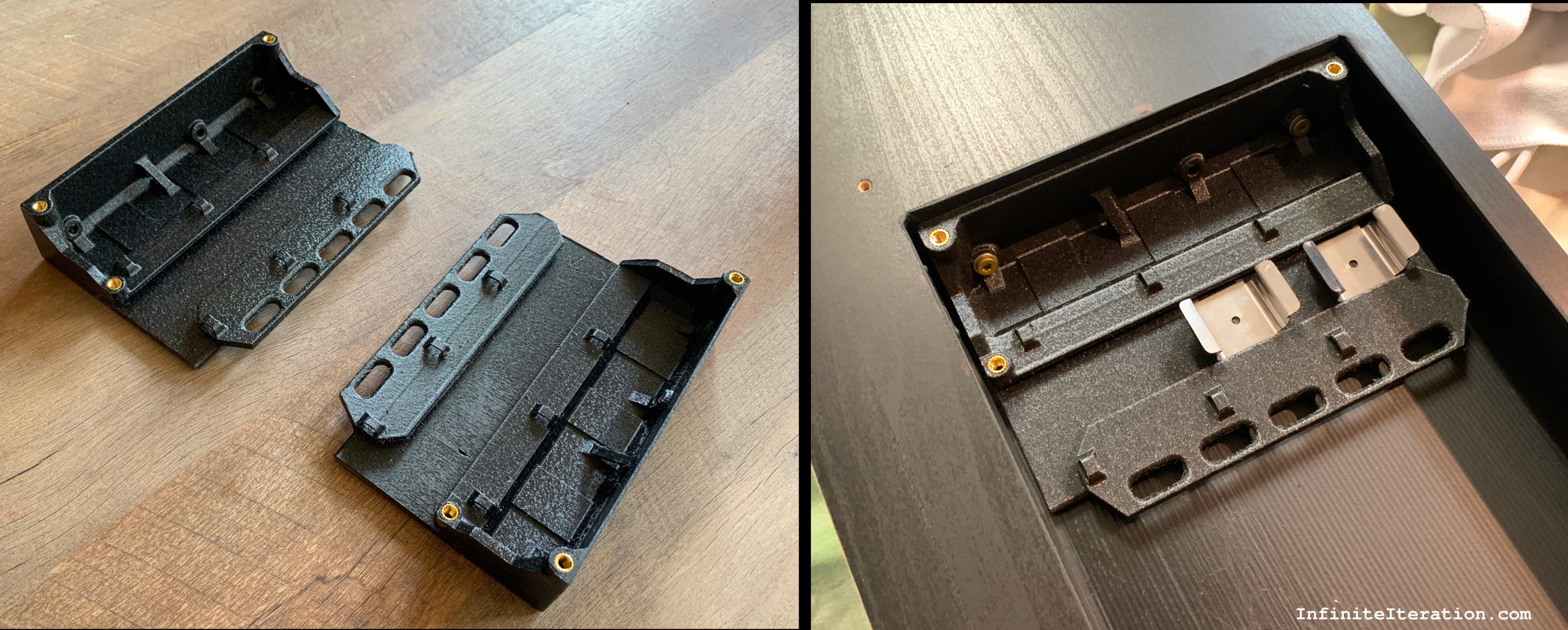
To hold the lights in place, I designed and 3D-printed custom mounting brackets that install into the shelf underside, attaching with angled screws into the adjacent internal chipboard blocks that the metal support tubes pass through. My custom brackets hold the grow lights’ mounting clips, allowing them to be installed and removed without fasteners. The brackets include cable-management features and provisions for a hanging diffuser and third bar light if I decide to add either of those in the future. The threaded heat-set inserts are for a cap/cover.
Mounting
I took my own light-output measurements in a dark closet, measuring PPFD (photosynthetic photon flux density) of ~300, 400, and 600 µmol/m2/s at 16″, 12″, and 8″ away respectively (both lights together).
Based on these measurements, I calculated the best vertical table-to-shelf distance for my plants, especially those growing vertically on my custom modular moss poles. I settled on a shelf height of 42″ above the table surface (~71″ above the floor).
I lined the shelf bracket up left-to-right to get the shelf edge flush with the wall corner. None of the existing bracket holes lined up with wall studs in that position, so I marked and drilled a few new holes in the bracket so I could pick up two studs. I used heavy-duty toggle anchors to secure the rest of the bracket – (3) TOGGLER 3/16″ Snaptoggle anchors and (5) EZ Ancor toggle anchors.
The shelf height necessitates some shielding around the lights, so I installed some 4″ hardboard panels around the border of the shelf (flush with the top), painted black with Krylon COLORmaxx Satin Black to match the Malm table described below. This way I can’t see the light bars directly even when lying on the couch.
Wiring
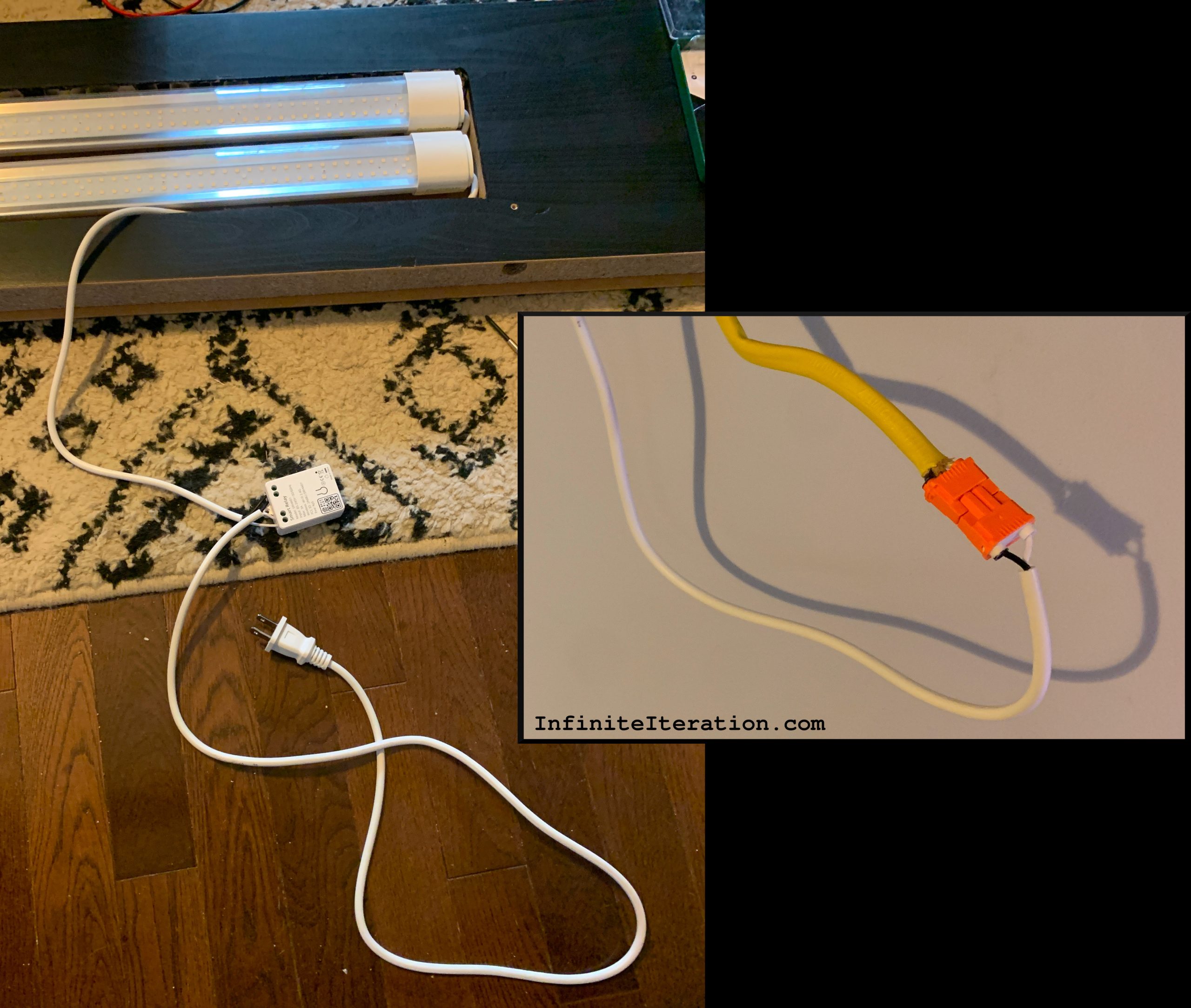
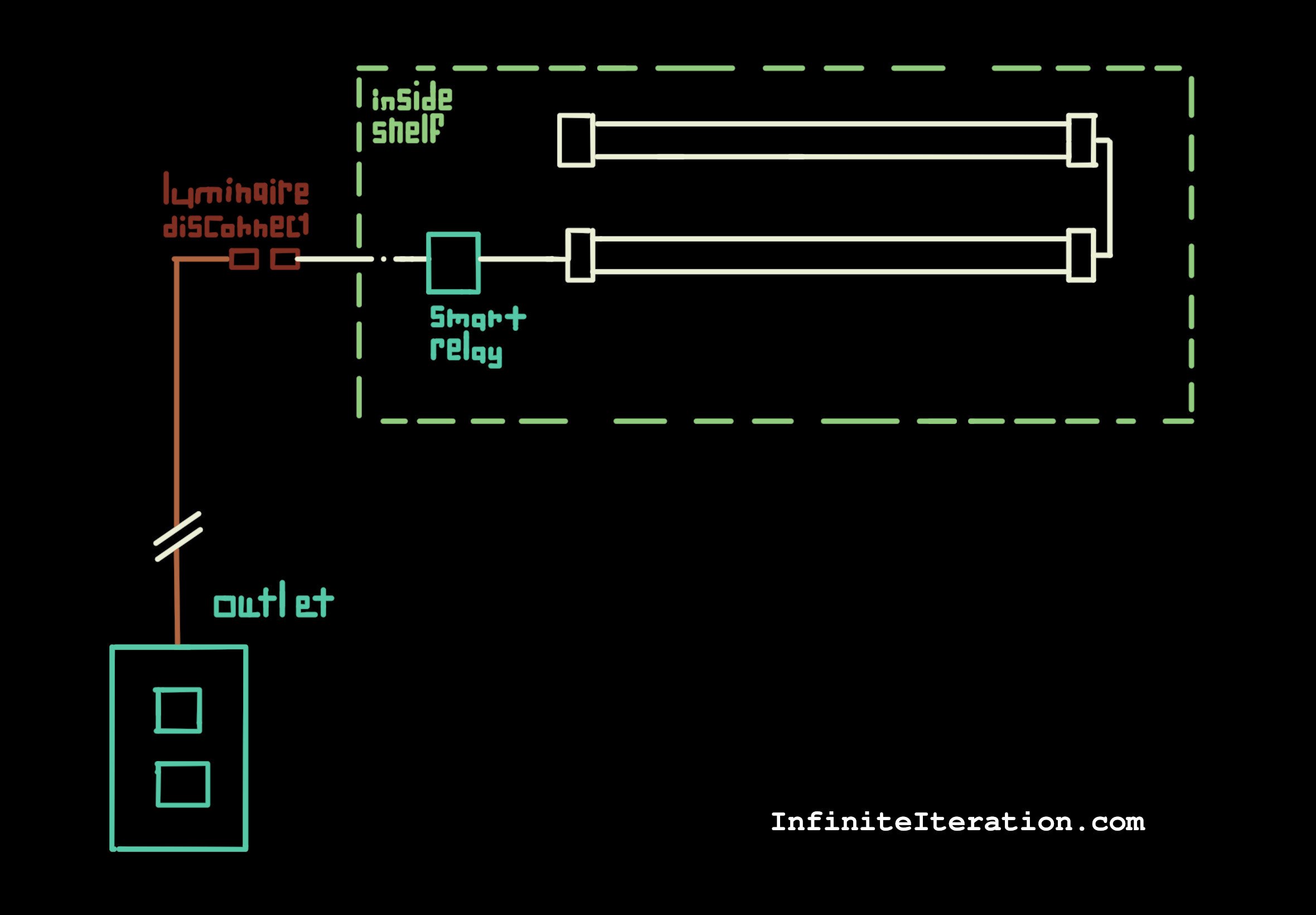
I didn’t want the lights’ power cord hanging down and ruining the aesthetic, so I wired power to the lights by running ROMEX from the back of the wall outlet below up inside the wall and out through the shelf bracket. I terminated the ROMEX with an IDEAL PowerPlug 30-1302S luminaire disconnect (F) to allow the shelf/light assembly to be removed from the wall nondestructively. It’s important to use female for the supply side so powered terminals are never exposed when the connectors are separated.
Between the shelf-side luminaire disconnect and the lights, I installed an Apple HomeKit-compatible EVVR Smart relay to allow remote control and automation. I set up an automatic schedule so the light turns on in morning and off at night; I can also manually control it through iOS, from home or remotely.
Table
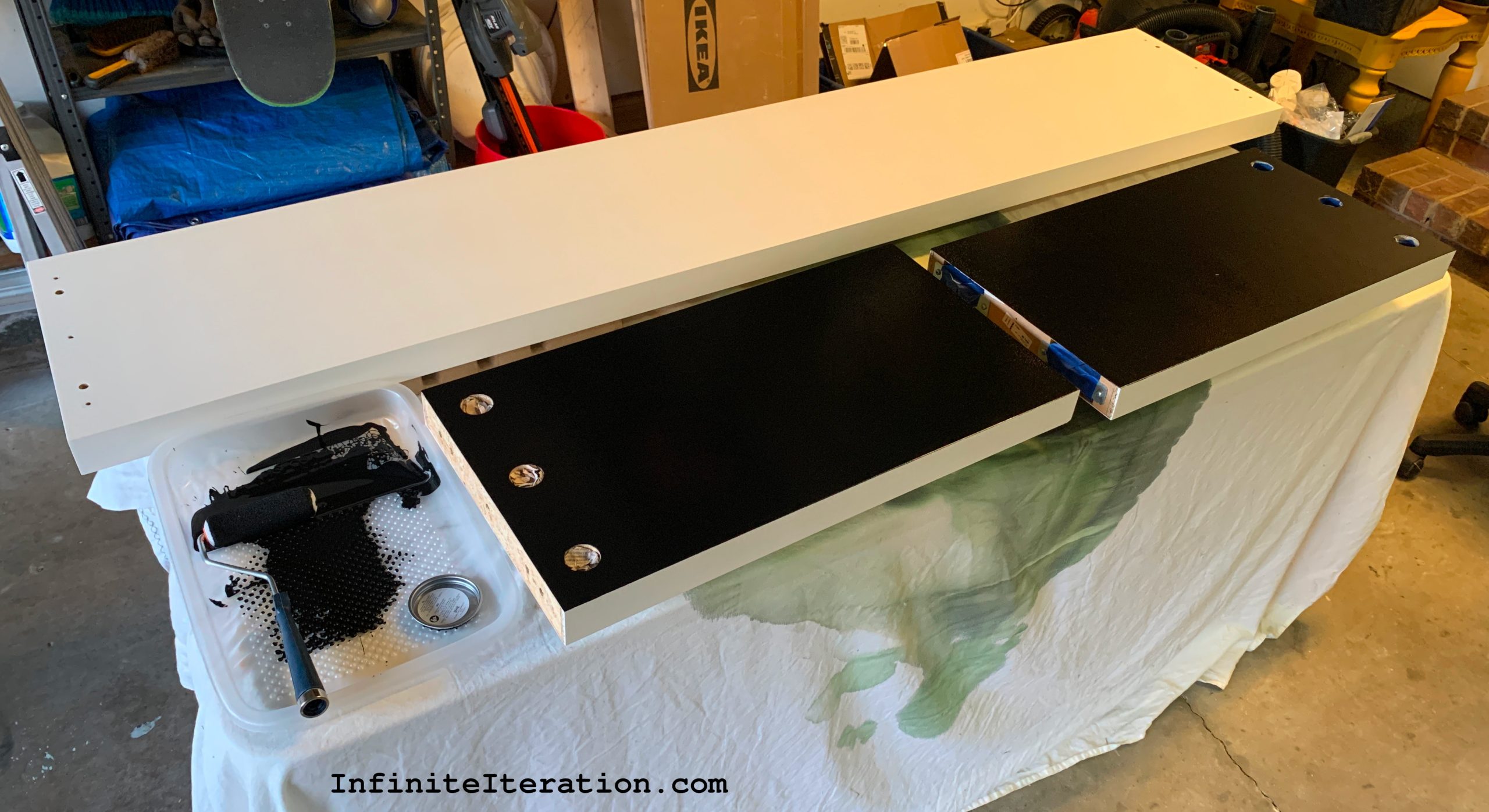
Holding my plants under the shelf/light combo, I have an IKEA Malm Occasional table (now discontinued – more pics here) of the same length and similar blocky style to the Lack floating shelf, but finished in white. I sanded it down, primed with Zinsser BIN shellac primer and repainted it black to match (all using foam rollers, based on recommendation here). First I tried using IKEA POPPARE black paint to best match the Lack shelf, but I had trouble getting the paint to properly adhere and cure (many online DIYers have struggled with this paint too). After much trying, I gave up and scraped and sanded off the IKEA paint, instead re-painting with Krylon COLORmaxx Satin Black. I applied three coats, sanding in between the first and second.
Light Power Consumption
Using the 80W quoted by Mars Hydro for both lights combined, adding in the (measured) 0.5W consumed by smart relay (open or closed), and assuming energy cost of $0.132/kWh, this is the yearly operating cost:
80.5W * 15 hr/day ≈ 1.2 kWh/d
1.2 kWh/d * 365 d/yr ≈ 440 kWh/yr
440 kWh/yr * 0.132 $/kWh ≈ $58/yr